When a lifting chain fails at a shipyard or on an offshore platform, the cost is measured in far more than the price of the component. Saltwater, constant humidity, temperature swings, and dynamic loading combine to make the marine environment one of the harshest operating conditions for any lifting and rigging product. For shipbuilders, port operators, offshore oil and gas crews, and marine equipment distributors, specifying the right marine-grade lifting chains and rigging is not a purchasing detail - it is a safety and compliance decision.
This guide explains what "marine-grade" actually means, which materials and products perform best in corrosive environments, the standards you should require from any supplier, and a practical buyer's checklist you can apply before issuing your next RFQ.
Why Marine Applications Demand Specialized Lifting Equipment
Standard carbon-steel rigging that performs reliably in a dry warehouse will degrade rapidly in a marine setting. Three factors make the difference:
Corrosion is the primary threat. Chloride ions in seawater attack unprotected steel through pitting and crevice corrosion. A chain that loses even 10% of its cross-section can fail well below its rated Working Load Limit (WLL).
Dynamic and shock loading are constant. Wave motion, crane swing, and vessel movement introduce side loads and sudden tension changes that stress components beyond static calculations.
Inspection and replacement are difficult offshore. Once equipment is installed on a platform or vessel, pulling it for inspection is costly. Components must be specified with margin and certified traceability from day one.
For these reasons, marine buyers should never treat lifting chains and rigging as commodities. Material selection, surface treatment, and certification are decisive.
Key Materials for Marine-Grade Lifting & Rigging
The single most important decision is the base material and its corrosion protection. The table below compares the options most relevant to marine use.
| Material / Treatment | Corrosion Resistance | Typical Use in Marine | Notes |
|---|---|---|---|
| Stainless Steel 316 | Highest (marine-grade) | Shackles, hooks, small fittings, blocks | Best against chloride; ideal for splash zones and submerged use |
| Stainless Steel 304 | High | Indoor marine, less aggressive exposure | Good general corrosion resistance; slightly below 316 in seawater |
| Hot-Dip Galvanized Alloy Steel | High (barrier protection) | Lifting chains, transport chains, hooks | Zinc coating sacrifices itself to protect steel; re-coatable |
| Black Oxidation / Electrophoresis | Low–Moderate | Indoor or temporary use | Not recommended as primary marine protection |
| PVC-Coated Galvanized Wire Rope | High (for rope) | Barrier, guardrail, tensioning | Coating adds abrasion and corrosion protection |
Rule of thumb: For components that sit in the splash zone or below the waterline, specify 316 stainless steel. For heavy lifting chains where stainless is impractical, specify hot-dip galvanized G80 or G100 alloy steel with documented proof-load testing.
Essential Marine-Grade Products from Z2LIFTING
A complete marine rigging package typically spans chains, fittings, hoists, and wire rope. The following products are part of Z2LIFTING's standard range and are suited - by material or treatment - to shipbuilding and offshore work.
Stainless Steel Shackles
The Stainless Steel Shackle is offered in sizes from 4 mm to 12 mm and manufactured from 304 or 316 stainless steel for maximum corrosion resistance. Screw-pin bow shackles are widely used in marine, offshore, and port applications where frequent connection and disconnection is required.
Marine Lifting Chains (G80 / G100)
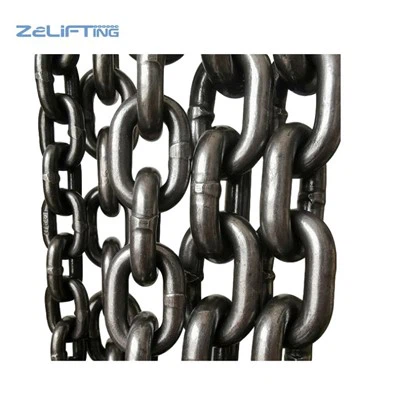
Z2LIFTING manufactures G80 Chain and G100 Lifting Chain Sling products from special-analysis alloy steel, quenched and tempered, and proof-tested to international standards. For marine exposure, specify electro-galvanized or hot-dip galvanized surface treatment. These chains comply with the mechanical and testing requirements of EN818-2 / AS 2321 for lifting chains and are suitable for overhead lifting and chain sling assemblies.
Stainless Steel Hoists and Trolleys
For lifting in corrosion-sensitive areas, stainless steel handling equipment removes the weakest link:
Stainless Steel Manual Chain Hoist - national-standard 304 body, suitable for food-grade, marine, and chemical environments.
Stainless Steel Beam Trolley - mounts on most I-, S-, and W-beams to move heavy loads; pairs with a manual or electric hoist.
Stainless Steel Hand Winch - for lifting, pulling, and tensioning where corrosion resistance is required.
Stainless Steel Pulley Blocks and Wire Rope
Stainless Steel Single Pulley Block - designed for rope, cord, or wire in indoor and outdoor marine applications, from kayaks to factory and shipping use.
Galvanized Wire Rope and PVC-Coated Galvanized Steel Wire Rope - helical steel-wire bundles for rigging, barrier, and tensioning systems; the PVC coating extends service life in wet, sun-exposed environments.
Webbing Slings and Ratchet Straps (Non-Critical Securing)
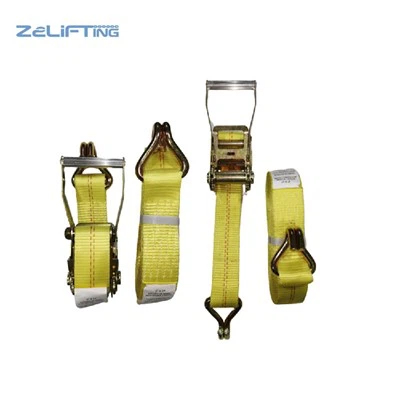
For cargo lashing and non-overhead securing on deck, Duplex Webbing Sling and Heavy Duty Ratchet Strap (100% high-strength polyester, WLL up to 5000 kg) provide lightweight, abrasion-resistant options. These are securing, not overhead-lifting, products and should be specified accordingly.
Understanding Standards and Certifications
Marine buyers operate under tightening safety and traceability requirements. Require the following from any rigging supplier:
EN818-2 - European standard for short-link lifting chains (grade 8 / grade 10). Confirms mechanical properties and testing.
EN818-7 - Standard for hoist chains; relevant when specifying chain hoists.
CE marking - Indicates conformity with EU machinery and safety directives; Z2LIFTING products carry CE approval.
ISO 9001 certification - Confirms the manufacturer operates a documented quality management system. Z2LIFTING (Hangzhou Zhezhong Chain Co., Ltd, established 2006) is ISO certified.
Proof-load and breaking-load test reports - Every lifting chain should be 100% proof-load tested, with batch-level traceability. Z2LIFTING performs material analysis, proof-load test, breaking-load test, elongation check, hardness check, and fatigue test as part of its INSPECTION & TESTS service.
Documented traceability matters offshore: when an auditor asks which batch a critical shackle came from, you must be able to answer.
How to Choose the Right Marine Rigging: A Buyer's Checklist
Use this checklist when specifying or sourcing marine lifting and rigging equipment:
Define the real Working Load Limit (WLL). Calculate the maximum dynamic load, not the static weight. Apply appropriate safety factors; for lifting, never exceed the marked WLL.
Match material to exposure. Splash zone or submerged → 316 stainless. Heavy chain lifting → galvanized G80/G100. Deck lashing → polyester webbing or galvanized chain.
Verify certifications up front. Request EN818-2 / EN818-7 compliance, CE marking, and ISO 9001 status before ordering - not after delivery.
Require test documentation. Insist on proof-load and breaking-load test reports with batch traceability.
Plan inspection and replacement. Establish a scheduled inspection regime (visual, dimensional, surface). Replace at the first sign of significant corrosion or deformation.
Source from a traceable manufacturer. Choose a factory that controls its own production process - forming, welding, calibrating, heat treatment, proof testing - rather than a trading intermediary.
Z2LIFTING Marine Solutions
Z2LIFTING is the trading name of Hangzhou Zhezhong Chain Co., Ltd and Ruby Imp & Exp Co., based in Hangzhou, China. Since 2006 the group has focused on manufacturing and supplying high-quality lifting, rigging, material handling, and marine equipment. The group is ISO certified, its products carry CE approval, and it has designed more than seven patented production devices - including chain calibrating machines, proof-test machines, and auto chain-stacking machines - to control quality at every production stage.
Beyond standard products, Z2LIFTING provides OEM and ODM services (logo, packaging, and color customization) and a complete INSPECTION & TESTS program covering quantity, packaging, dimensional, surface, and mechanical checks. For marine distributors and shipbuilders building long-term, safety-critical supply relationships, this combination of in-house manufacturing and verification is the core value proposition.
Conclusion
Specifying marine-grade lifting chains and rigging for shipbuilding and offshore applications comes down to three non-negotiables: the right corrosion-resistant material, verifiable international certifications, and a manufacturer that controls and documents its own production. By applying the buyer's checklist above and sourcing from a traceable factory, you reduce both safety risk and total cost of ownership.
If you are planning a marine, offshore, or port project and need a configured rigging package - chains, shackles, hoists, and wire rope matched to your WLL and environment - contact Z2LIFTING for a quotation and full test documentation.